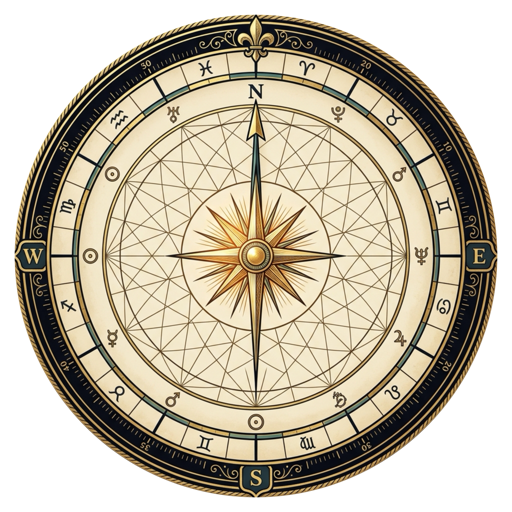
A transit is not a prediction. It is the real sky, still moving, passing over the fixed map you were born under.
Your birth chart is a snapshot: where every planet stood at the moment you arrived. It does not change. The sky keeps turning, though. When a moving planet reaches a meaningful angle to a point in your chart, that meeting is a transit. Most slide by unfelt. A few land squarely, and those are the ones worth knowing.
The map and the weather
Think of your chart as a map and transits as weather moving across it. The map is the terrain you carry: where your Sun sits, where your Moon is, the angles that shape how you meet the world. The weather is what is passing over that terrain today. A good map does not tell you it will rain. It tells you which ground floods when it does.
Why most transits pass unnoticed
The sky is always making angles to something, and most of them are background. A transit gets your attention when the moving planet meets a sensitive point closely: a personal planet, an angle of your chart, a place that already carries weight for you.
Distance is what separates the loud from the quiet. A planet within a degree or two of exact makes itself felt; the same planet ten degrees off is barely a whisper. This is why a horoscope written for a whole sign so often misses. It calls the day bright for every Leo, with no idea whether the moving sky is anywhere near your own Sun. It cannot see which points in your chart are actually being touched today.
How to feel one coming
You do not need to predict a transit to use it. You need to notice the theme it carries and the part of your life it touches. Saturn asking you to build something slower. Jupiter opening a door you had stopped watching for. The work is not to guess the outcome; it is to recognize the season while you are standing in it, and to meet it on purpose instead of by surprise.
That is orientation, not fortune-telling. The same instinct the Arcturus Compass is named for: reading the sky to find your bearings, the way navigators once did.
Letting the ones that matter reach you
The hard part is catching a transit while it is happening, not weeks after. That is what Personal Moments do inside Celestium. It watches the sky against your actual chart and tells you when a transit is genuinely meeting one of your points, when one is forming, and when the sky is simply quiet. You read what it means for your real day, and keep the moments that land.
Celestium computes all of it on your device, from a real ephemeris. You can download it free on the App Store for iPhone, iPad, and Mac, or first hear 90 seconds of your chart read aloud.